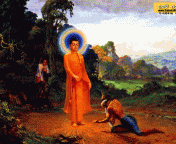
mahapajapati Gotami was the younger sister of mahamaya or maya the mother of prince Siddhartha, When Maya died mahapajapati Gotami bacame the step-mother to nfant Siddhartha, She even paid more attention to him tan to her own son nanda, lest the orphan infant prince would feel the absence of his mother. She fed and nursed Siddhartha with love and tender care. Siddhartha, too, was extremely attached to her.
She, with king Suddhaodana, did everything possible to make Siddhartha’s life happy. When Siddhartha left household-life, she lamented very much. Since then she devoted all her time to look after the rest of the family, her husband, her son, and also yasodhara and Rahula. later when nanda and Rahula became nonks, she felt extremely sad and lonely. With the death of Suddhaodana the last strong bond that kept her bound to household-life snapped. She had no more reason to remain in the household. She waited for an opportunity to meet the Buddha and obtain his permission for ordination.
This opportunity came when the Buddha visited kapilavatthu to settle the dispute between Sakkyans and neighboring kolliyasn as to the right to use water form river Rohini. On this occasion mahapajapati Gotami led a deputation of a large number of women whose husbands had become monks,. and requested the Buddha to grant them permission to be ordained as bhikkhunis. But the Buddha refused permission thinking that it would create problems in the Buddhst community.
However, Mahapajapati Gotami and her followers did not given up hope, They got barbers to cut off their hair; dressed themselves in yellow robes and went on foot to Vesali, where the Buddha was. Walking along the rough, gravel road under the heat of the scorching sun their feet were covered with dust and were full of blisters.
Once again Mahapajapati Gotami pleaded with the Buddha for permission to be a bhikkhuni. The Buddha however, refused permission again. The she approached Venerable Ananda and informed him of their plight. he intervened on their behalf and spoke to the Buddha on three occasions, and on all three occasions he refused to grant permission. Then Venerable Ananda Decided to change his approach.
He very very reverntially asked the buddha whether the women are capable of understanding the Truth. The buddha said that they are quite capable. Venerable Ananda seized this opportunity and asked the Buddha, if that is so why not they be permitted to become bhikkhunis. The Buddha agreed with Venerable Ananda and granted them permission to become bhikkhunis subject to eight important conditions.
Mahapajapati Gotami became the first bhikkhuni. She was followed by many others including Yasodhara. And Within a very shot period the community of bhikkhunis increased in number, and among them were very illustrious bhikkhunis such as Kheme, Uppalavanna and Dhammadinna.
Learn more »
First two lay disciples
On the full moon of the night of May, while sitting in deep meditation under a Bodhi tree, at Gaya city, Eastern India, Siddhattha Gotama attained Enlightenment, real happiness, and became Buddha, the Awakened One. Two merchants called Tapussa and Bhallika passed by and seeing the Buddha sitting under the Budhi tree, they offered him a meal of honey cakes.
After eating the food, the Buddha talked to them about his new experience, and the two merchants became his first lay disciples, the first Buddhists. The Buddha, at the time of his enlightenment, was thirty-five years of age.
The students may have a question in mind, “What is Enlightenment ?” The answer is that enlightenment is the state of pure mind, The mind is free from ignorance, from hatred, and from craving. The mind is in the state of being enlightened and comprehending truth.
First sermon and first monk disciple
Now the Buddha was ready to begin his mission of teaching his doctrine to the people. He asked himself to whom should he first teach the Doctrine. His mind turned to his former teachers, namely, Alara Kalama and Uddhaka Rama. However, the two teachers had already died. He then recalled the five companions with whom he had lived before setting out to seek Elightenment alone. They were still at Deer Park of Isipatana(near Benares City),about one hundred miles away. The Buddha went there. At deer Park, he gave his First Sermon, during the Asalha month (full moon day of july). It was known as Dhammacakkappavattana Sutta, the Turning of the Wheel of Dhamma or Truth.
After the sermon, the five ascetics Kondanna, Vappa, Bhaddiya, Mahanama, Assaji realized the Eye of Dhamma, or Truth. Kondanna realized liberation first and asked for monkhood. The five ascetics became the first Noble Disciples of the Buddha.
Missionary activity
Early one morning, while the Buddha was sitting in Deer Park of Isipatana, a young man named Yasa, who was born into a wealthy family came near by the Buddha and saw him. Upon hearing the Buddha’s teaching, he realized that life was full of dissatisfaction, problems and troubles, and asked to become a monk to find real happiness.
Soon after that, the Buddha converted Yasa’s parents and wife to Buddhism. The Venerable Yasa had fifty-four lay friends. Having learned of Yasa’s ordination, they agreed to follow him and were ordained into the order. Within a few days, Yasa and his friends became Arahants (Enlightened monks). The total number of Arahants was then sixty-one.
Preaching Movement
Seeing that there were now enough disciples to begin sharing the Truth, the Buddha told his disciples to separate and wander from place to palce to teach the truth to the people. He himself set out on a long journey for the same purpose.
Throught out the forty-five years of his mission and his limitless kindness to all human beings, the Buddha selflessly devoted his life to teaching the Dhamma, the Path leading to real happiness. He travelled widely in northem and eastern India, stopping only during the rainy season, when he and his disciples, both monks and nuns, would go into the Rains Retreat. Through the efforts of the Buddha his followers, Buddhism was firmly established in india about 588 years before the Christian Era. The Buddha (Siddhattha) was born about 623 years before Christ.
Last instruction of the Buddha
At the age of eighty, while on his way to Kusinara City, the capital of Malla State, the Buddha became ill because he ate a meal of tainted food offered by Cunda, a poor toolsmith. The Buddha told Venerable Ananda, his faithful attendant, to console Cunda, and to tell him that his food-offering, which was the Buddha’s last meal, was of great fruit and merit and that he should not blame himself for the Buddha’s illness.
The Buddha travelled to the Sala Grove of Mala State, where the Buddha told the Venerable Ananda to prepare a couch between two Sala trees. Then he laid down on his right side, still mindfull and self-possessed. The monks assembled about him.
Although he was about to pass away, when men came to him to be received into the Order, he accepted and gladdened them with a sermon on the Dhamma. Of those men, Subhadda, mendicant wanderer, a poor man, was the last one who was ordained by the Buddha. He realized Arahantship before the Buddha’s death.
On his death bed under the two Sala trees, on the full moon night of Visakha month (may), the Buddha said to his disciples;
“O Bhikkhus, you will not be left without a Teacher, because the Docteine and the Discipline. I have taught and down for you shall be your Teacher when Iam gone.”
He said again, “ decay is inherent in all component things! O bhikkhus, work out your own salvation with diligence.”
These were the last words of the Enlightened One. His face shone as luminous gold. His mind ascended to the realms of ecstasy. He realized Nibbana, theEnlightenment and passed away form the eyes of human beings forever. His teachings have remained to guide us for all time. After the passing away of the Lord Buddha, his maleand female disciples continuedteaching the Dhamma to the people and maintain Buddhism to the present time.
Learn more »
Dissociating fools, associating wise and paying honour to those who deserve honour- This indeed is a Blessing Supreme.
Life in a befitting place, good deeds done in the past and aspirations that are noble and high- This indeed is a Blessing Supreme.
Well learned and thoroughly skilled, disciplined and properly trained, pleasant in every utterance made- This indeed is a Blessing Supreme.
Looking after one’s dear parents and maintaining the family and wife, engagement in a decent profession – This indeed is a Blessing Supreme.
Charity as well as righteous conduct, helping relatives and blameless activities – This indeed is a Blessing Supreme.
To avoid and shun all evil and to abstain from intoxicating drinks, diligence in all matters concerned- This indeed is a Blessing Supreme.
Reverence, humility and contentment, gratitude as well as hearing of Dhamma at proper times- This indeed is a Blessing Supreme.
Patience, obedience and the sight of holy sages, participation Dhamma discussions at proper times- This indeed is a Blessing Supreme.
Self control, noble life, realisation of the Nibbana as well – This indeed is a Blessing Supreme.
A sorrowless, stainless and secure mind that remains unshaken before vicissitudes of life– This indeed is a Blessing Supreme.
Conducting themselves in this manner they remain victorious in all spheres and attain happiness everywhere- To them these indeed are Blessings Supreme, ETAM MANGALAM UTTAMAM.
Learn more »

The two basic character istics of a Buddhist. One is his taking refuge in the Buddha, Dhamma and Sangha the TISARANA- with confidence. The other is his observation of the Five Precepts – PANCASILA.
A perso who, out of confidence, accepts the Buddha as the perfect teacher who could guide, the Dhamma as the perfect teaching to be practised and the Sangha as the perfect example to be follwed, takes them as his refuges a long as his life lasts. After that he begins his spiritual journey leading to the ending of dukkha by his undertaking to observe the Five Percepts. This is because moral conduct or virtue, Sila forms the first lap in his forward march towards mental culture, Samadhi and wisdom, Panna. he begins this journey by earnestly declaring his intention to observe the Five Precepts which contain the minimum moral duties expected of a lay Buddhist.
He says:
1) I undertake to observe the precept regarding abstention from killing – panatipata veramani sikkhapadam samadiyami-
2) I undertake to observe the precept regarding absten – tion from anything not given. – adinnadana veramani sikkhapadam samadiyami-
3) I undertake to observe the precept regarding absten- tion from indulging in unlawful sexual relations.. – Kamesu micchacara veramani sikkhapadam samadiyami-
4) I undertake to observe the precept regarding absten – tion from speaking lies. – musavada veramani sikkhapadam samadiyami-
5) I undertake to observe the precept regarding absten- tion from taking intoxicating drinks. –surameraya majjhapamadatthana veramani sikkhapadam samadiyami-
The Five precepts are of personal as well as of social significance. A man is basically a private individual; but at the same time he has to be concerned not only about himself but also about the society in which he lives. All his actions influence the society and all actions of the society influence him. It is because of this mutual influence that an individual should lead a life that is beneficial to himself as well as to the society. observance of the Five Precepts helps to lead such a life.
The First Precept is about abstention from killing. Though his precept means abstention from killing any living being, its main focus, however, is on human beings. The Buddha teaches that life is very dear to all. E everyone has the right to live safely. This is a basic human right, and each member of the society should help to safeguard this right. The First Precept acknowledges this basic human right and makes everyone, who follows the teachings of the Buddha, to uphold this right. If each and every member undertakes to abstain from killing, then every member of the society will be abstain from killing, then every member of the society will be able to enjoy his basic right to safe living. The Second is about the safety of personal property. This, too, is a basic human right. When one declares to abstain from taking anything that is not given to him, it directly assures the safety of personal property of other members. When each and every member of a society agrees to uphold this precept naturally there will be no fear of losing one’s personal possessions. In a society where there is no stealing all members will be able to live with peace of mind enjoying their personal property. They will enjoy the Bhoga-sukha, the happiness of being able to enjoy one’s possessions without any obstructions.
Family is the basic unit of the society . The unity and strength of the society depends on the unity and strength of each family. It is mostly the women folk, specially the mother, that helps to strengthen the family unity. Therefore, to protect the family, protection of women in the family is very important. The Third precept is mainly aimed at protecting happy family life. This precept makes one undertake to refrain from indulging in sexual relations with women who are under the protection of others. A wife is under the protection of a husband, daughters are under the care and protection of parents, brothers and other elders. Similarly, unmarried females are under the custody of other elder members. Any attempt to have sexual relations with such protected female members is unlawful. Such attempts lead to severe conflicts and will certainly ruin families. A society in which there is no safety of family life is bound to decline.
The Fourth Precept is regarding telling lies. The Buddha has said that a person who is capable of telling lies is capable of any other crime. Though this precept is mainly about abstention from telling lies, it covers all forms of abuse of speech namely, lying, tale-bearing, harsh-speech and idle-talk. Speech is a unique power of man. It is an asset as well as a liability. The Buddha’s advice is to use speech carefully and speak what is right. If this is not possible one should observe golden silence.
Abuse of speech leads to misunderstandings, quarrels and even to murders. Proper use of speech brings about friendship, harmony, mutual understanding and co-operation. Therefore one should always be truthful; he should always try to speak good of others, what is beneficial to to others; never should one use harsh speech that units the feelings of others; never should one engage in idle-talk which does no good to anyone.
Addiction to intoxicants has always been a major social problem. This is more so now. Buddhism clearly points out that all intoxicants cause physical ailments and mental confusion. Besides, addiction to intoxicants courses loss of wealth loss of shame and reputation; it increases quarrels quarrels and conflicts. Intoxicants damage the brain, cause inactivity carelessness. They are called ‘maddening substances’. Buddhism is most concerned about the ill-effects intoxicants have on an individual’s intellect. They blunt the intellect and prevent the development of insight that enables one to see things as they truly are.
Abstention from these five wrong-doings is only the negative side of the Five Precepts . There is a positive side, too. While abstaining from killing one should do everything possible to make others live happily. While refraining from stealing, one should practice giving (dana).While abstaining from unlawful sexual relations one should even regulate one’s lawful sexual relations . While abstaining from speaking what is untrue , one should always be truthful, speak in appreciation of the good qualities of other , use pleasant speech and always engage in meaningful talk .While abstaining from intoxicants one should consume only what is not harmful to one’s physical and mental health.
Thus it is seen that the observance of the Five Precepts is beneficial to oneself , and to the whole , will contribute to make the world a pleasant place to live in.
Learn more »
Wishing to attain that state of supreme peace
The skilled one should his virtue increase;
Efficient should he be; straightforward and upright
Disposed to agree, very gentle, humble downright.
Contented, easily supportable, in basic needs including food,
Having duties few, and practicing a simple livelihood
With all senses under control, careful and discreet
He should never be attached to families through greed.
He should never do even the slightest wrong
For which the wise would censure him with words strong.
He should wish, ‘May all be comfortable and secure;
May all be happy, with their minds made pure”
Whatever kinds of living beings that are there
Weak or strong, long, big or of size medium and fair,
Quite shot, very small whether bulky in size they are
Whether they are seen or not seen with eyes bare,
Whether living close be or not living close anywhere
Whether they are already born or seeking to be born somewhere
The one skilled in good and seeking that peaceful state
Should always wish for their happiness and welfare.
One should not by any means deceive another,
Nor should he ever look down upon the other
Let no one through anger and ill-will swear
For the downfall, harm and suffering of another
Just as a mother would guard her only child with care
Risking her own life in a manner bold and dare,
Even so he should develop boundless kindness of heart
Towards all living beings that are here and everywhere.
let boundless kindness of heat spread all round
All over the world with no exception found
High above, down and far across the world
With neither hatred nor enmity, keeping kindness under check and hold.
Whether one stands or walks around
Sits or lies down, wakeful with the mind sound
In all such postures he should be with mindfulness firm
This indeed is the “Sublime State here”, this they confirm.
Never filling prey to views that are not right
Having developed virtue and possessing sharp insight
Giving up greed for sense-pleasures, allowing none to remain
Such a person is certainly not destined to be reborn again.
Learn more »
S.K. Barua
Every religion has certain sacred objects of devotion in which the followers are exported to have confidence. it is the fervent belief in this sacred objects which awaken the religious impulse in a man and which in turn inspire him to lead a religious life. In Buddhism, the solemn assertion of truth, based on absolute truth, is a spiritual power, formulated to avert the impending catastrophe and also to word-off the influence of evil sprits dispel fear and ailment.
The motive power an assertion of truth (Satya Kriya is mind-force. The strong aspiration of a man is bound to achieve its desired results. Firm determination and a strong will could therefore fulfill a man’s wish. Of course, to produce the desired effect the assertor should be a person of moral integrity and he should possess the particular virtue on which he relied to make the assertions.
To bring this creative force into practice, it is of primary importance for us to understand the nature of powers of life all about, to learn the most suitable method of using them, to acquire knowledge of the best way to combine them together so that the motive power we seek may dawn within our heart.
We can attain the highest state of mental development by an earnest effort, but it is to note that we cannot always force the effort or energy, form ourselves despite our resolve . Energy (Vijja) can only arise if the right conditions are present. The motivation to do good and cease to do evil are the factors that can stimulate the energy. In this way we can employ a mighty mind force by right understanding for our own welfare and that of all beings.
It is the highly developed mind force that led Prince Siddharta, in his last struggle to attain the enlightenment. Underneath the Bodhi Tree at Uruvela he sat, with a firmed determination “Let my flesh and blood dry up, my skin, ligaments and bones, but from this seat, i rise not till the perfect Enlightenment is attained”
Ultimately, he won, and in winning that last flight, Prince Siddhartha become the Buddha, a fully Enlightened One . There are in our holy Tripitaka many instances were Arahants had done the acts of truth. Our jataka book is rich in acts of truth . In same jataka we find that, the mother of Bodhisatta made an assertion of truth to revive her only son who was in death bed, resulting from a lathel does of poison. Her act of truth ran thus , If it be true that sama lived virtuously and spokes the truth and nursed his poisons night and day, may it over power the poisons strength and may our darling Son not die. Sama did not die, he was restored to life . Here the assertor and the assertee possesss the sama virtue. In maha Sutasoma jataka , the Bodhitta made an assertion of truth which brought solace and comfort to those who were in imminent peril of life.Here Bodhisatta stands the ideal example of truth .It was his persistent aim never to deviate from the path of truth. This is the potency of the act of truth . Eversince Angulimala joined Bhikkhu Sangha , he had maintained such a high sense of purity of life , so much so that , he was able to relieve the pains of a young mother and effect a safe delivery ,by making the following act of truth ,Since my birth in Buddha’s Order (Sangha) ,O sister ,I know not that i have intentionally killed any living being . By this truth may . You be well , may the child you bear be born well. It is an intance no ted for it’s peculiar circumstance and the act of truth attributed to the Arahanta , Angulimala . The twenty-three Paritran Sutras (Discourse of Protrcrion) found scattered in five Nikayas of the Sutra Pitaka , are a from of Satya Kriya (Act of Truth) of depending on the truth for protection, justification or attainment. Devotion to these discourse and full concentration of mind to the recitation, tend to stimulate the potrntial energy in man . A person who recites or listens to these sayings of Buddha, with complete confidence or Sadda, will acquire such a virtuous State of mind that may enable him to conquer any civil influence.
The Ratana Sutra (Jewel Discourse) is one of the most supreme act of truth among the many acts of truth perfotmed by the Buddha. The occasion for the assertion of truth was originated in the City of Visali when the country was ravaged by famine and epidemic. Buddha visited the place and directed the Bhiddshu Sandha to recite the Ratana Sutta and asked them to sprinkle the holy water from His alms bowl. In all there are twelve acts of truth in it, each act of truth emphasizes the distinctive virtues of the Buddha; the Dhamma and the Sangha. (Tripple Gem). At the end of each stanza buddha blessed every one saying, “BY THIS ACT OF TRUTH MAY ALL BEINGS BE HAPPY AND BLISSFUL.” At the end of the proceedings a welcome shower fell upon the city to the great relief of the Citizons, Great was the rejoicing in the land!
It is the Solemn assertion of truth, a mighty mind-forcer and it’s potential energy that bring relief to the sorely tormented Vijjis of Vaisali.
The mind of a person given to just passion and execssive indulgence in pleasure of the senses is really defiled. If a person harbors ill-will toward others, he is far from purity, Ravenge malice pride, intolerance, self-gratifi. caption and other fallings of that nature are the defilements of mind. These defilements take hold of the mind. and keep the mind under thir sway. As such, the mind-force of a common person is comparartively low. The mindforce of a person who has suppressed the defilements by wisdom is more power ful. And the mind force of the coppassionate Buddha, who has exter-minated and rooted out all defilements is indeed the most powerful. It has the power to penetrate the cosmos and go beyond the confines of time and space to the unconditioned.
The vices latent in a man seem to be almost natural and spontenous, and it is equally true that every vice possesses it’s opposite sterling virtue. Greed, hatred and delusion (lobha, dosa, moha) which are the deepest roots of human sorrow, must eventually be ower come and eliminated through coltivation of virtue, contemplation and wisdom (Sila, Shmadhi and Panna). The four other vices namely Dosa (Anger), Himsha (cruelty), lssa (Jealousy) and the attachment to pleasurable and aversion of non-plea-surable are the evil forces which can be subdued or eleminated by cultivationg the sublime virtues. Metta (lovingkindess), karuna (copassion), Mudita (Appreciable joy)and upekka (Equenimity) are collectively termed as Brahmavihara. These four sterling virtues tend to elevate man. if cultured throughly, it chn subdue all defilements and can transform a man into a supermen. The sublime state of mind has the power to counteract all hostile influences. The cossation of attachment to self and eradication of all defilements are the final goals of Buddhism. To atain the highest state of mental development, the first step to practive is the moral conduct (sila) which consists of trainging oneself to restrain from killing, stealing, adultery, falsespeech and intoxicating-drind (Pancha Silla). The second step to practice is mental training by concentration of mind (Samadhi and thirs step is the practice of the highest knowledge (Panna or wisdom) which when carefully cultivated, lead a man from darkness ton light, from passion to dispassion and from turmoil to tranquillty.
Meditation develops the power of mind, it sharpens the willpower by which the meditator
chn penetrate into the subtle problems of life. By cultivating the seven fold purification (shpta visuddhi) as illustrated in the visuddhi magga, a devotee can purify his know-ledge or attain wisdom through seven successive stages.
Hence, this is the only way through which one could manage to attain the potential energy to get rid of his sufferings and maintain peace and hurmony ny using his effort and wisdom.
SABBE SATTA SUKHITA HONTU
MAY ALL BEINGS BE HAPPY.
Learn more »